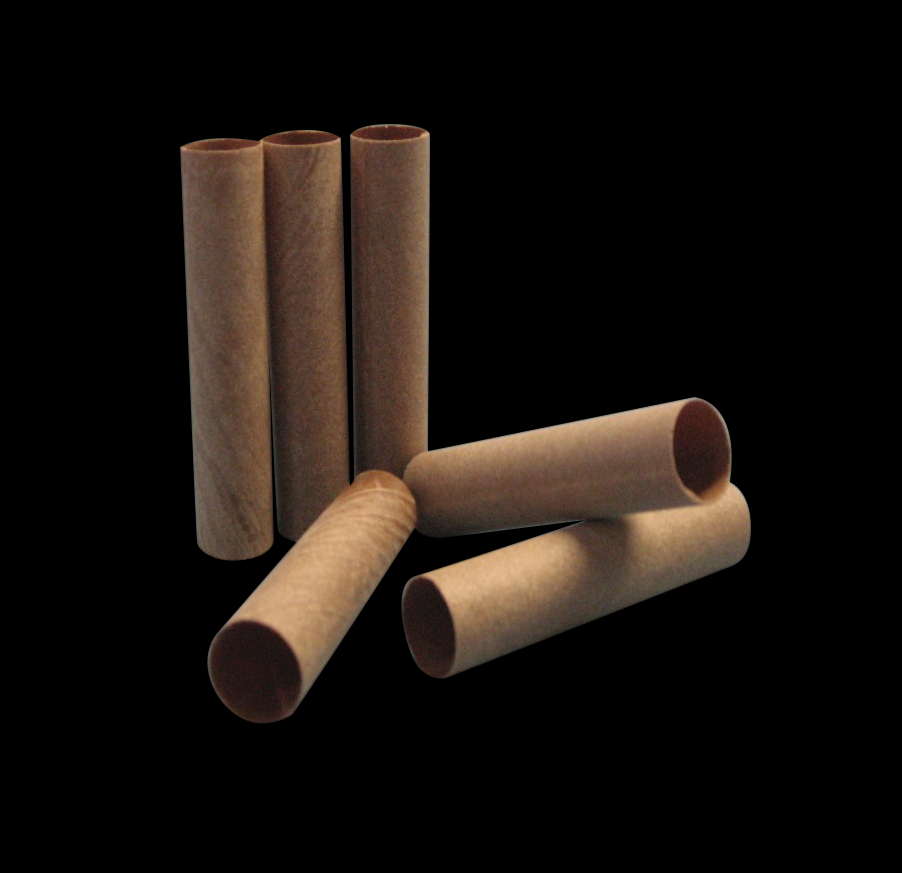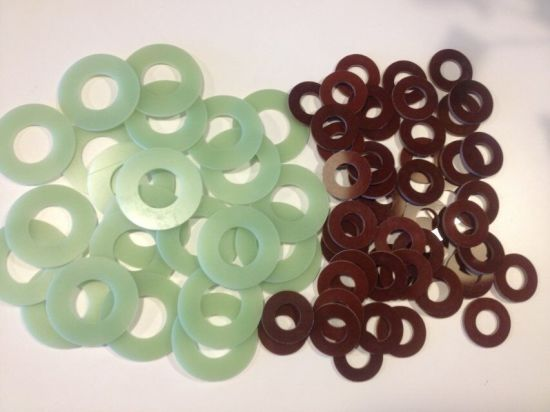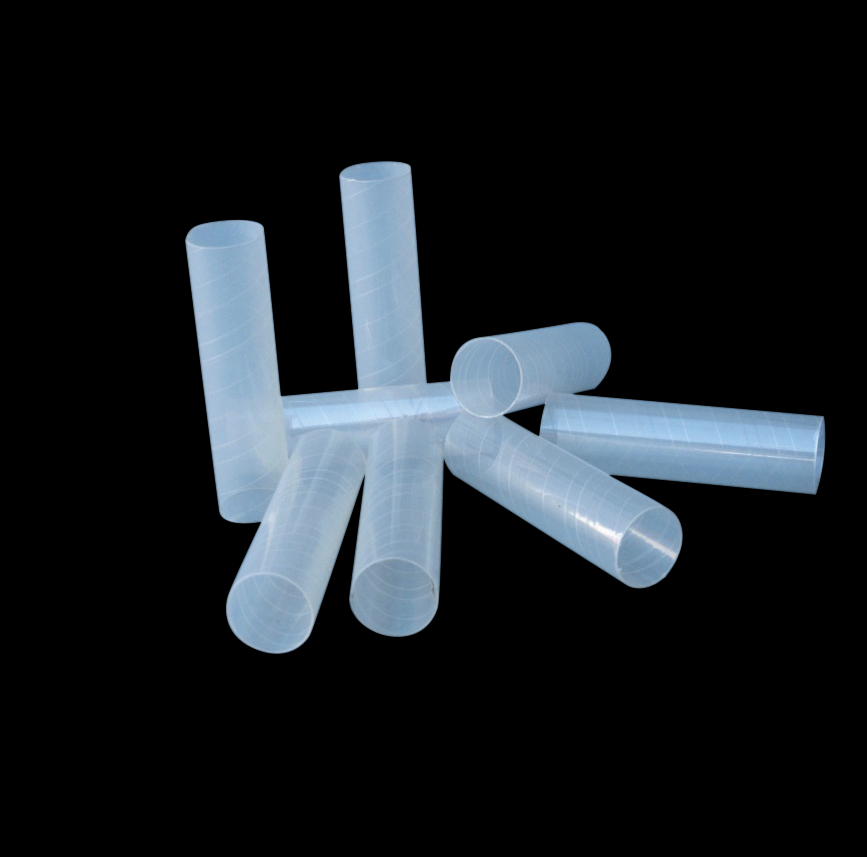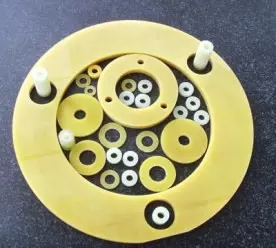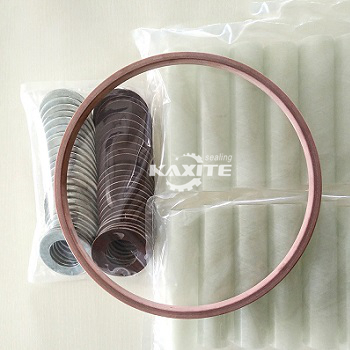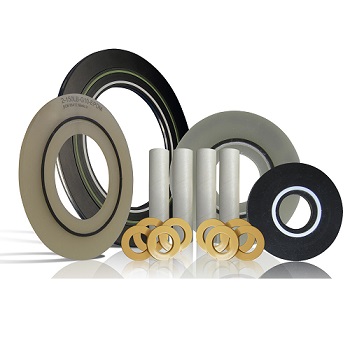

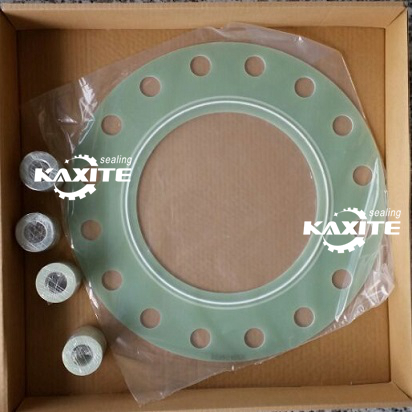
Kaxite Type E flange insulation kits are full-face isolation kits for raised-face and flat-face flanged joints. The gasket has the same outside diameter as the flange, with precision-located bolt holes — so the entire mating surface is protected from contact corrosion and the gasket self-centres on the flange inside diameter without a separate centring ring. Each kit is supplied complete: full face insulating gasket, insulating sleeves and insulating washers, pre-packed to match the flange bolt pattern. After installation, the exposed flange edge can be taped to prevent foreign material bridging the isolation gap — the standard anti-shorting measure on buried and outdoor lines. Materials include reinforced phenolic, Minlon and Mylar. Kits are available for ASME B16.5, ASME B16.47, API 6A and DIN/EN flanges, Class 150 through Class 2500.
Type E flange insulation kits are the full-face isolation solution for raised-face and flat-face flanged joints. Where Type F covers only the raised face inside the bolt circle, the Type E gasket has the same outside diameter as the flange itself — a full face profile with precision-located bolt holes — so the entire mating surface is protected from contact corrosion, not just the seal area.
The full-diameter geometry gives Type E two advantages in the field: the gasket self-centres against the flange inside diameter (no separate centring ring needed), and once installed, the exposed edge of the flange can be taped to prevent foreign material from bridging the isolation gap — a common failure mode known as "shorting out" of the flanges.
The gasket outside diameter matches the flange outside diameter. The entire mating surface — not just the seal area inside the bolt circle — is protected from metal-to-metal contact.
Precision bolt holes plus the same outside diameter as the flange mean the gasket centres itself on the flange inside diameter during installation. No separate centring ring or special tooling is required.
After installation, the exposed flange edge can be wrapped with insulating tape to prevent foreign material bridging the isolation gap — the standard "anti-shorting" measure on cathodically protected lines.
Flange insulation is used wherever two flanges must be joined without creating an electrical path between them. The two drivers are the same across every kit type: prevent galvanic corrosion between dissimilar metals, and keep the joint isolated on pipelines that use cathodic protection.
Type E is the full-face variant for raised-face and flat-face flanges. The choice between Type E and Type F comes down to one question — do you need to protect the full face of the flange, or only the surface inside the bolt circle?
An insulating gasket only works if it is the only path between the flanges. On outdoor and buried lines, wind-borne dust, rain splash and insects can bridge a narrow isolation gap on an exposed flange edge, effectively short-circuiting the insulation. Wrapping tape around the flange exterior after installation is standard practice on Type E joints for exactly this reason — and the full face profile makes that wrap easier to apply than on a narrower Type F gasket.
Each Type E kit is supplied as a complete isolation set — no missing parts, no second-order required on site. The three core components and the standard material options are listed below.
Outside diameter matches the flange OD. Precision-located bolt holes to the standard drilling pattern. Thickness selected to match the flange pressure class.
One per bolt hole. Sized to the bolt diameter and flange stack thickness so the bolt shank cannot contact either flange face through the hole.
Under each nut (and typically under each bolt head) to complete the isolation path. Combined with the sleeves, they break all current paths through the bolting.
The default material for most Type E kits. High compressive strength, excellent dielectric properties and proven performance across the service temperature range of standard industrial flanged joints.
Minlon (mineral-reinforced nylon) where higher toughness and impact resistance are needed — offshore and heavy industrial piping. Mylar (PET film) for thin-section washers and specific tight-profile kit configurations.
The four standard flange insulation kit types are not interchangeable — the correct choice is driven by the flange face geometry. Use the table below to match your flange to the right kit.
| Kit Type | Flange Face | Gasket Profile | Typical Application |
|---|---|---|---|
| Type E | Raised face / flat face | Full face — same OD as flange, precision bolt holes, self-centring on ID | Full face protection; outdoor and buried lines where shorting risk is high |
| Type F | Raised face | Inside bolt circle only | Standard raised-face joints where the seal area is the only concern |
| Type D | RTJ (ring joint) | Profiled for the ring groove | High-pressure oil & gas, API 6A wellheads, refinery piping |
| Type B / C | Raised face | Application-specific variants | Special bolt-hole patterns or legacy flange specifications |
Not sure which type fits your flange? Send the flange drawing, standard (ASME B16.5, ASME B16.47, API 6A, DIN/EN) and pressure class and we will confirm the correct kit and material.
Send the following five details and Kaxite will confirm the correct kit type, material, and lead time — typically within one working day for standard sizes.
The Type E gasket has the same outside diameter as the flange, giving full face protection and self-centring on the flange inside diameter. The Type F gasket covers only the area inside the bolt circle. Choose Type E when the full face must be protected or when the joint is exposed to outdoor conditions where foreign material could bridge the isolation gap.
The insulating gasket only works if no other electrical path exists between the two flanges. On exposed flanges, wind-blown dust, insects or water splash can bridge the gap between the flange exterior surfaces, effectively shorting out the isolation. Wrapping the exposed edge with insulating tape after installation prevents this. The full face profile of the Type E kit makes the tape wrap easier to apply than on a narrower Type F gasket.
Yes. Type E kits are produced for all common flange standards — ASME B16.5, ASME B16.47, API 6A and DIN/EN — across Class 150 through Class 2500 and equivalent pressure classes. Send the standard, size and pressure class on your drawing and we will confirm availability.
For high-pressure and offshore service where vibration and impact loads are present, Minlon is the recommended material for its higher toughness and impact resistance. For standard onshore industrial piping, reinforced phenolic is the default. Send the working pressure, temperature and media and we will confirm the correct material.
Every Type E kit is supplied pre-packed as a complete set — one full face gasket, the correct number of sleeves and washers for the flange bolt pattern, and any additional isolation components required. The pack is labelled with the flange size and rating so it can be matched to the joint on site without error.
Standard sizes ship from stock or on short lead time — typically 7–15 days depending on quantity. Custom or non-standard sizes are produced to order, generally 15–30 days. Send the specification for a confirmed delivery schedule.
Yes. In addition to complete kits, Kaxite supplies insulation washers and insulation sleeves as individual components for maintenance and replacement needs. See the phenolic sleeve and phenolic insulating washer product pages.
Yes. Custom bolt patterns, non-standard outside diameters and legacy flange specifications are produced to order. Send the dimensioned flange drawing and we will quote accordingly.
Send the flange standard, size, pressure class and quantity. Kaxite will confirm the correct kit type, material and lead time. If your flange is RTJ, we will recommend the Type D kit instead; if only the raised face needs isolation, the Type F kit is the more economical choice.